


Alli360 by Kids360
ANKO Solutions LLC
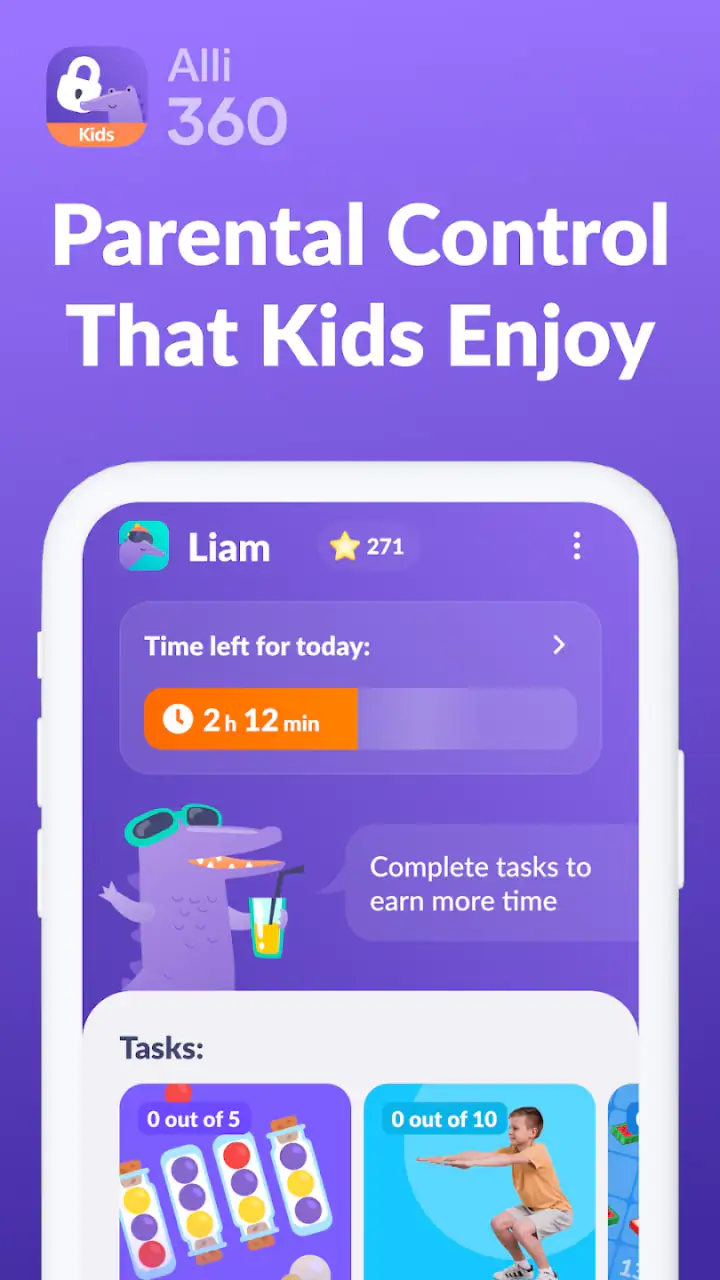
When I tried Alli360 by Kids360, I found a parenting app built around one practical problem: keeping games and mobile applications from quietly taking over a child’s day. It is not trying to replace family conversations or become a complete digital-safety suite. Its role is narrower and, in many homes, more useful because of that. You use it to bring structure to screen time, especially when a child moves between several games and apps rather than using one device for a single purpose.
The first thing I noticed is that the app makes screen-time management feel like an ongoing routine instead of a one-time punishment. A parent can use it as a gentle boundary on school days, a stronger limit before bedtime, or a way to make weekend rules different from weekday expectations. That flexibility matters because a single identical limit rarely suits homework, travel, holidays, and ordinary evenings equally well.
Alli360 is free, carries an Everyone age rating, and comes from ANKO Solutions LLC. It has reached more than a million installs and holds a 4.5 average from roughly 234 thousand ratings, which suggests that the basic idea has found a substantial audience. I would still treat those figures as a starting point rather than a guarantee: the real question is whether its approach fits the way your family handles devices.
How I would build a reliable daily routine with Alli360
Start with observation before tightening the rules
My strongest advice is not to begin by blocking everything that looks distracting. First, I would watch how the device is actually used. A child may spend time in a game, a messaging app, a video app, and a school-related tool, but those activities do not deserve the same treatment. The useful first step is separating essential applications from entertainment rather than treating every minute on the phone as identical.
That distinction is where a screen-time manager becomes more helpful than a kitchen timer. A timer can end a session, but it does not help a parent think through which applications should remain available for a specific purpose. With Alli360, I would establish a simple baseline: keep necessary tools accessible, place recreational apps under clearer limits, and avoid changing several rules at once. This makes it easier to tell whether a new setting improves the household routine or merely creates arguments.
Latest News

Uber Eats Under Pressure: What Happens When Delivery Goes Wrong

How QR & Barcode Scanner Adapts to Android and iOS Innovations

Why Waze Navigation & Live Traffic Is Your Essential Travel Companion

CapCut Mastery: Unleash Hidden Features for Pro-Level Editing

How OS Updates Enhance Roblox Adventures

Teacher Simulator: Exam Time Turns Quick Classroom Judgments into a Repetitive Loop
A realistic example is a child who returns from school and immediately opens a game while homework is waiting. Instead of removing the game for the entire day, I would make the after-school period predictable: school tasks first, a defined leisure window afterward, and a calmer device routine near bedtime. The important part is consistency. If the rule changes every evening, the app becomes a source of negotiation rather than a support for the family agreement.
Use the app as a reminder of the agreement
Parents often hope a control tool will do the explaining for them, but that is not how I would use Alli360. I would explain the rule away from the moment of conflict, then let the app enforce the boundary consistently. That changes the conversation from “Dad or Mum is taking the phone away” to “This is the schedule we agreed on.” It does not eliminate frustration, but it can remove some of the personal drama around every stopping point.
This approach also helps with younger children who do not yet understand elapsed time well. A verbal warning may feel abstract, while a predictable end to an app session is easier to learn. Older children may respond better if they are involved in choosing reasonable limits. I would give them a voice in the schedule without handing over the final decision, particularly when school, sleep, and family routines are affected.
Gallery
Make separate decisions for different kinds of use
One non-obvious advantage of thinking in categories is that it prevents a common mistake: using one harsh limit for the entire device. A reading tool, school application, and casual game may all appear in the same usage history, but their value is different. If everything is restricted equally, children may see the system as unfair and parents may end up granting exceptions constantly.
I would instead ask three questions for each frequently used application: does it support a real responsibility, is it mainly entertainment, and does its use tend to continue longer than intended? The third question is especially important. Some games are easy to stop; others encourage “one more round.” Alli360 is most useful when the limits reflect those behavioral differences rather than simply targeting the applications a parent happens to dislike.
Check the routine on ordinary days, not only during crises
Screen-time tools are often installed after a difficult evening, when everyone is already tired. That is a poor moment to judge whether a setup works. I would review the arrangement after several normal days and look for practical signs: Is homework starting more smoothly? Is bedtime less delayed? Is the child asking for fewer extensions? Are parents spending less time manually checking the device?
If the answer is no, I would adjust one part of the routine rather than abandoning the whole idea. Perhaps the leisure period begins too late, perhaps the limit is too strict for a weekend, or perhaps an application has been placed in the wrong group. Small changes are easier to explain and easier for a child to accept than a complete reset of the rules.
Settings that deserve a careful look
Because Alli360 is a management tool rather than a game, the quality of the experience depends heavily on how thoughtfully the parent configures it. I would not rush through the initial setup. The most important choices are the applications being managed, the times when restrictions should matter, and the difference between a normal day and an exceptional one.
Before relying on it, I would check the device compatibility requirement. The current version is 2.75.9 and supports Android 7.0 or later. That makes it suitable for many older Android phones, but families using several devices should still verify that the child’s actual phone meets the requirement. A rule is not useful if it is being applied to the wrong device or if a second device remains outside the routine.
I would also pay attention to whether the selected limits match the child’s real schedule. A short limit may be sensible on a school morning but unnecessarily restrictive during a long journey. Conversely, a generous daily allowance can quietly consume the evening if it is not paired with a bedtime habit. The best setup is not necessarily the strictest one; it is the one that leaves less room for last-minute bargaining.
Think in repeatable settings, not constant exceptions
Experienced use of Alli360 is less about finding a perfect number and more about reducing the number of decisions made under pressure. If a child repeatedly needs an exception for a family trip, that is a sign the routine should account for trips in advance. If homework requires access to a browser or educational application, that should be discussed before the limit interrupts the task.
I would create a small family rule around exceptions: explain why an exception is happening, keep it tied to a specific purpose, and return to the normal routine afterward. Without that habit, exceptions can become the real schedule. The app then appears inconsistent even when the settings themselves are working correctly.
Another useful check is whether the child understands what will happen next. A limit feels more reasonable when the child knows when recreational access will return. I would pair the digital boundary with a visible offline alternative: dinner, a shower, reading, preparation for school, or a family activity. Alli360 can control access, but it cannot fill the empty space that appears when a screen is removed.
Where faster patterns save effort
The most efficient pattern is to decide rules in calm moments and let them repeat. Parents who manually negotiate every session are likely to become inconsistent, especially when work and household responsibilities compete for attention. A stable setup reduces that mental load. Once the family understands the routine, the parent can review it occasionally instead of rebuilding it every evening.
I would also avoid changing several application limits at the same time. If a child suddenly loses access to multiple favorite apps, the conversation will focus on the restriction itself. Changing one category or one part of the schedule makes the result easier to observe. This is a simple but surprisingly valuable troubleshooting method: one adjustment, several days of observation, then another adjustment only if needed.
For families with more than one child, I would resist the temptation to copy the same arrangement automatically. Even when siblings use similar phones, their ages, school demands, and self-control may differ. A shared family principle can be fair, while the actual limits remain individual. Treating identical settings as the only form of fairness often creates unnecessary conflict.
Use conversations to make the controls work better
A child who understands the reason behind a limit is more likely to cooperate than one who only sees a locked application. I would explain that the goal is not to label games as bad. The goal is to protect sleep, school responsibilities, and time away from the phone. That explanation should happen before the first restriction, not after the child discovers it unexpectedly.
There is also a useful distinction between access and trust. A limit does not have to mean the parent believes the child is dishonest. It can simply acknowledge that games and mobile applications are designed to hold attention. This framing is particularly helpful with older children, who may reject controls that sound childish but accept a clear household rule applied for a practical reason.
Limits that experienced users should understand
Alli360 is not the right answer for every digital-parenting problem. Its store summary focuses on managing screen time for games and mobile applications, so I would not choose it as my only solution if my main concern were broader online safety, content filtering, location awareness, or detailed communication monitoring. A family looking for those functions may need a different kind of parental-control product, or a combination of tools.
It also cannot solve a disagreement about parenting by itself. If one adult allows unlimited evening gaming while another enforces a strict cutoff, the child will quickly learn that the real issue is the adults’ lack of agreement. I would settle the family policy first and use the app to make that policy easier to follow.
Another limitation is emotional rather than technical: a restriction can still trigger anger, especially when it ends a game at an inconvenient moment. I would not promise a completely frictionless experience. The practical benefit is that the boundary can be more predictable and less dependent on a parent remembering to intervene manually. That is a meaningful improvement, but it is not the same as universal acceptance.
When a different option may be better
If your child uses several devices, you should think about the whole device environment rather than focusing on one phone. A screen-time app is only as effective as the coverage of the routine. If the child can simply move to a tablet, another phone, or a computer that is not part of the plan, the result may feel disappointing even though the original setup works as intended.
I would also consider skipping Alli360 if your family has no clear need for app-specific boundaries. Some children respond well to a short family agreement and occasional reminders. Installing a control tool in a home where everyone already manages screen use comfortably may add administration without adding much value.
On the other hand, it is a sensible choice when the problem is repeated overuse of entertainment apps, especially when parents are tired of acting as the timer themselves. It is also a reasonable starting point for families that want a focused screen-time tool rather than a large collection of unrelated monitoring features.
My practical verdict after using its approach
I see Alli360 as a focused parenting app that works best when it supports a clear household rhythm. Its strength is not a flashy promise; it is the possibility of turning vague instructions such as “put the phone away soon” into a repeatable boundary around games and applications. That can make ordinary evenings calmer, provided the parent has already decided what the boundary should be.
The free price removes an obvious barrier for families who want to try a structured approach, and the Everyone rating makes its intended audience broad. The developer, ANKO Solutions LLC, has kept the product centered on a recognizable parenting need rather than presenting it as a solution to every online risk. I appreciate that focus, although it also means users should not expect it to replace broader safety tools.
My recommendation is to begin with a modest setup, explain it clearly, and observe the family routine before making it stricter. Use different expectations for school days and free days where appropriate, keep exceptions purposeful, and review the arrangement when real life changes. The app becomes much more effective when it is part of those habits rather than the entire parenting strategy.
My bottom line: I would recommend Alli360 to parents who need consistent limits around games and mobile applications and want to reduce nightly negotiations. I would be more cautious for families seeking comprehensive monitoring or device-wide safety controls. Used with honest conversations and a repeatable schedule, it is a practical screen-time companion; used as a substitute for those conversations, it will feel more restrictive than helpful.
FAQs for Alli360 by Kids360
What is Alli360 by Kids360 and how does it work?
Alli360 by Kids360 is an application designed to help parents monitor their children's online activity. It provides tools to track app usage, set screen time limits, and receive alerts for potentially harmful content. The app works by syncing with the child's device, allowing parents to have a comprehensive view of their digital habits.
Is Alli360 by Kids360 safe and secure to use?
Yes, Alli360 by Kids360 prioritizes user privacy and security. The app employs robust encryption protocols to safeguard personal data. Additionally, it complies with international privacy regulations, ensuring that your child’s information is kept confidential and used solely for monitoring purposes.
Can I customize the app's monitoring features?
Absolutely. Alli360 by Kids360 offers customizable settings to suit your family's needs. Parents can set specific screen time limits, block certain apps, and receive customized alerts. This flexibility allows you to tailor the app's functionality according to your child's age and maturity level.
Does Alli360 by Kids360 require a subscription?
Alli360 by Kids360 offers both free and premium subscription plans. The free version provides basic monitoring features, while the premium version includes advanced functionalities such as detailed activity reports, real-time alerts, and enhanced security settings. Subscription options are available on a monthly or yearly basis.
Is Alli360 by Kids360 compatible with all devices?
Alli360 by Kids360 is compatible with most Android and iOS devices. Before downloading, ensure that the app supports your device’s operating system version. The app is regularly updated to maintain compatibility with the latest devices and software updates, ensuring a smooth user experience.
Pros
- User-friendly interface for parents.
- Comprehensive activity tracking.
- Customizable alerts and notifications.
- Secure data encryption.
- Cross-platform compatibility.
Cons
- Limited free features.
- Requires constant internet connection.
- Occasional app crashes.
- High battery consumption.
- Subscription can be costly.


